VENMO CONCEPT
From domestic only, to
international payments
Venmo’s users are already global. Venmo isn’t, yet. This case study assumes international payments are enabled and focuses on one product problem: the difference between what you send and what they receive should never be a surprise.
*Infrastructure, compliance, and regulatory requirements are assumed to be in place.


Outcomes
Received amount became the primary reference point
All participants identified the received amount as the most important number.
Total cost understood before authorization
All participants understood how fees and the exchange rate affected the total cost.
All participants successfully completed the payment
All participants completed the payment after reviewing all transaction details.
**Based on two rounds of moderated usability testing with 10 participants - designers, engineers, business professionals, and international users across diverse backgrounds.
Usability tester,
No surprises before you confirm
Venmo’s international payment flow makes the received amount and total cost explicit before authorization, so the sender knows exactly what they’re paying, and the recipient gets exactly what was intended.
THE INTERNATIONAL PAY FLOW
Every step, accounted for
Transparency at every step
The sender always knows what lands on the other side.
*A video walkthrough is shown here to preserve the integrity of a specific transaction. The experience is built around a set amount and sequence that a static prototype wouldn’t communicate clearly.

Context
Venmo’s simplicity is the product
But Venmo stops at the border
Venmo has over 90 million domestic users. The global P2P payments market is projected to reach $16 trillion by 2034.* The infrastructure gap is a missed market.
Today, those 90 million users split dinner in Paris, send birthday money to London, and have family in countries Venmo can’t reach.
Two numbers, one transaction
Cross-border payments introduce international transfer fees and foreign exchange rates on top of the conversion. The difference between what you send and what they receive isn’t always clear before authorizing payment.
“Venmo just works in the most simple way possible. If it worked globally and I could trust the rates, I would use Venmo forever.”
“Exchange rates and fees are confusing. I just want to know exactly what I’m paying upfront.”
How might we show transparency across every touchpoint in the experience?
The flow
Six steps, no surprises
Here’s the full journey - six steps, two moments where the experience diverges from domestic.
Reframing the approach
Cross-border payments often require people to piece together how much the recipient will receive. Leading with the sent amount makes the outcome less prominent.
Declare intent
Venmo’s domestic flow gives Pay and Request equal visual weight, making it easy to select the wrong action. A segmented control declares intent before anything else, so every step that follows is built around one clear direction.
Request or Pay
Domestic
vs.
Before
Pay and request compete

After
Shift the reference point
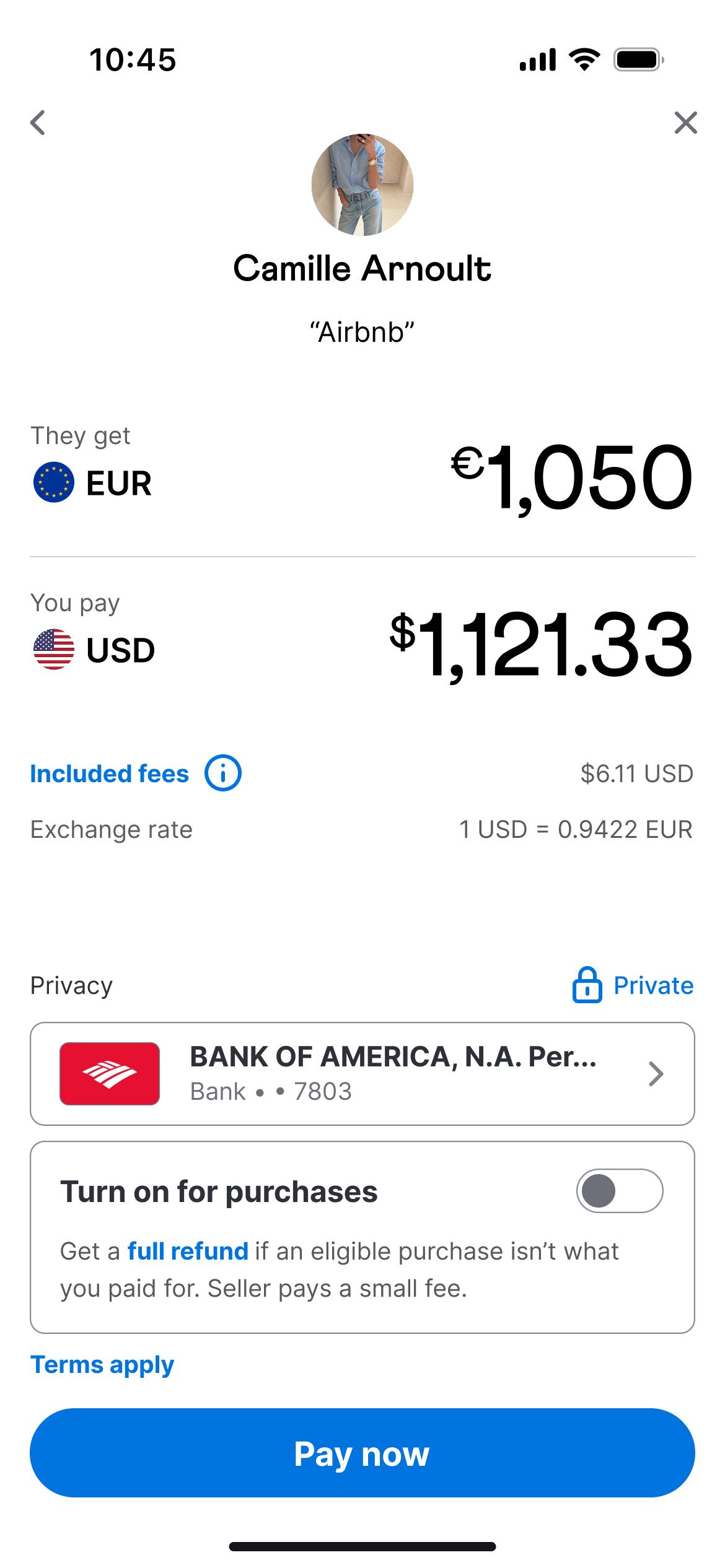
Making the received amount the primary reference point makes the outcome immediately clear instead of something users have to calculate.
Domestic
vs.
Before
What you send is what they get

Pay
After
What they get is shown first
Pay now
Make every cost explicit
The sender can see what they’re paying and why. The exchange rate is shown alongside a 30-day history, allowing the sender to evaluate the rate. Fees are broken down into two distinct line items.
No markups, no guessing.


Every fee, broken down.
The sender knows exactly what they’re paying before they confirm.
What this unlocks
What clarity actually brings
When cost is explicit before authorization, the sender knows exactly what they’re paying and what the recipient will receive. That clarity is what makes the payment safe to complete.
The next time a user faces a cross-border transfer, they reach for Venmo instead of an alternative.
“This feels like Venmo, but smarter. I would actually use this when traveling with my friends.”
Usability tester,