VENMO CONCEPT
From domestic only, to international payments
Venmo’s users are already global. Venmo isn’t, yet. This case study assumes international payments are enabled and focuses on one product problem: the difference between what you send and what they receive should never be a surprise.
*Infrastructure, compliance, and regulatory requirements are assumed to be in place.


Outcomes
Received amount became the primary reference point
All participants identified the received amount as the most important number.
Total cost understood before authorization
All participants understood how fees and the exchange rate affected the total cost.
All participants completed the payment successfully
All participants completed the payment after reviewing all transaction details.
*Based on two rounds of moderated usability testing with 10 participants - designers, engineers, business professionals, and international users across diverse backgrounds.
No surprises before you confirm
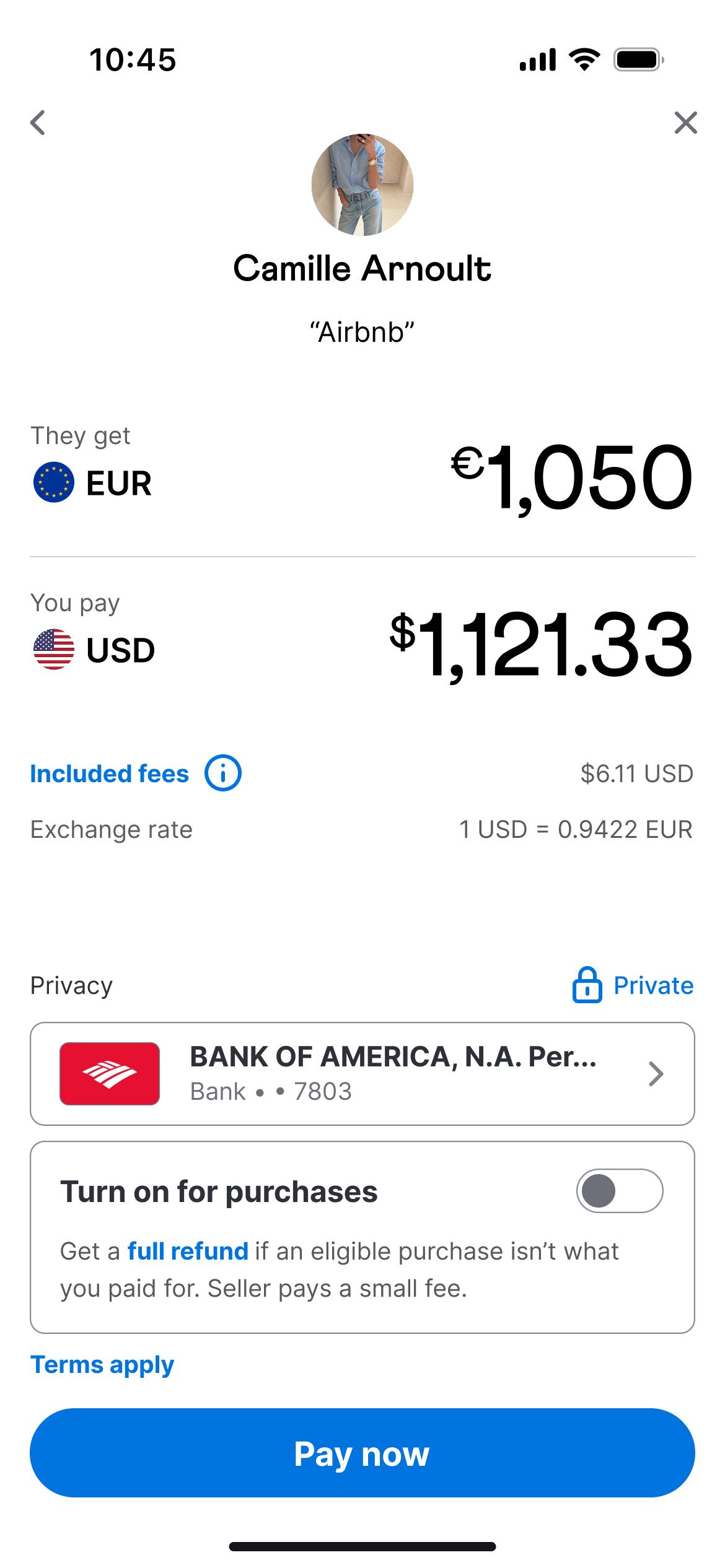
Venmo’s international payment flow makes the received amount and total cost explicit before authorization, so the sender knows exactly what they’re paying, and the recipient gets exactly what was intended.
THE INTERNATIONAL PAY FLOW
Every step, accounted for
Transparency at every step
The sender always knows what lands on the other side.
*A video walkthrough is shown here to preserve the integrity of a specific transaction. The experience is built around a set amount and sequence that a static prototype wouldn’t communicate clearly.

Context
But Venmo stops at the border
Venmo has over 90 million domestic users. The global P2P payments market is projected to reach $16 trillion by 2034.* The infrastructure gap is a missed market.
Two numbers, one transaction
Senders anchor on what they’re entering, not what lands on the other side.
How might we show transparency across every touchpoint in the experience?
The flow
Six steps, no surprises
Before diving into each decision, here’s the full journey.
Declare intent
Intent had to be established before anything else.
Request or Pay
Domestic
vs.
Before
Pay and request compete

After
Shift the reference point
Here, the received amount becomes the primary reference point.
Domestic
vs.
Before
What you send is what they get

Pay
After
What they get is shown first
Pay now
Make every cost explicit
By authorization, nothing is new.

Every fee, broken down.
The sender knows exactly what they’re paying before they confirm.